Alex Raymond
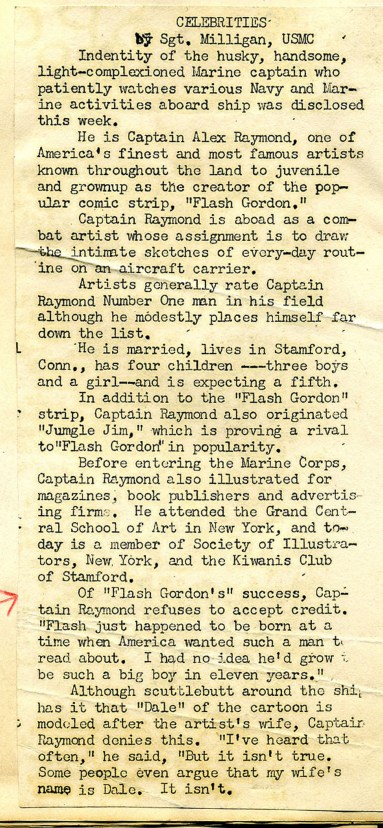
Major Alex Raymond made a famous mark for himself when he created Flash Gordon in 1934. His groundbreaking use of color and attention to detail are widely recognized as setting new standards in the comic art form. His career was cut short, at age 46, by an auto accident in 1956 but by then he had created three other cartoon strips that also became popular … ‘Secret Agent X-9’, ‘Rip Kirby’ and ‘Jungle Jim’. On-line references about his life point out he left King Features to join the service in 1944. Some say erroneously that he joined the Army, and others that he served on the battleship Gilbert Islands. Actually, he joined the Marines in February 1944 and eventually went out on the 1945 cruise of the escort carrier USS Gilbert Islands. Here he is in his USMC uniform showing the battle stars earned by the Gilbert Islands for action in the Pacific Theater. (All photos on this page are thumbnails – click on one to see it full size.)
I first became aware of Raymond’s Marine Corps service from Captain Lally. Other Marines have since told me more. However on-line searches for further information on Raymond’s Marine Corps career proved fruitless.
Enter Tom Roberts. Tom created a book on Alex Raymond – here is the cover:
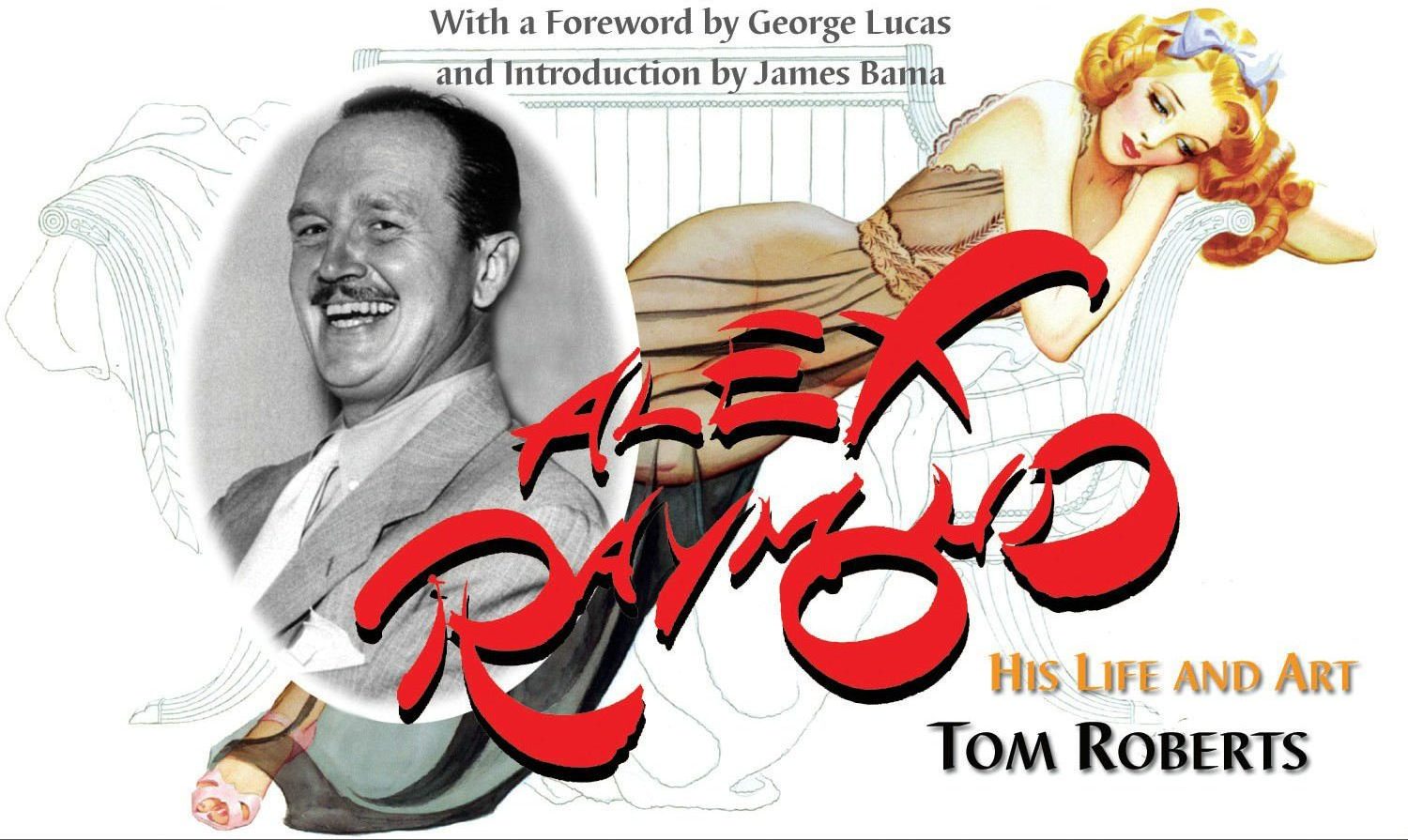
Tom found my pages on Captain John Lally and the USS Gilbert Islands, contacted me, and thus began a most enjoyable collaboration. Tom kindly sent a large group of Alex Raymond’s art for my viewing pleasure, including the photo of Raymond in uniform (above). I was awed by the art, and, since I know many of the men in them, at the life-like fidelity of the images. Also, I was able to match some of the art to photos I had copied from the veterans albums (more on this below).
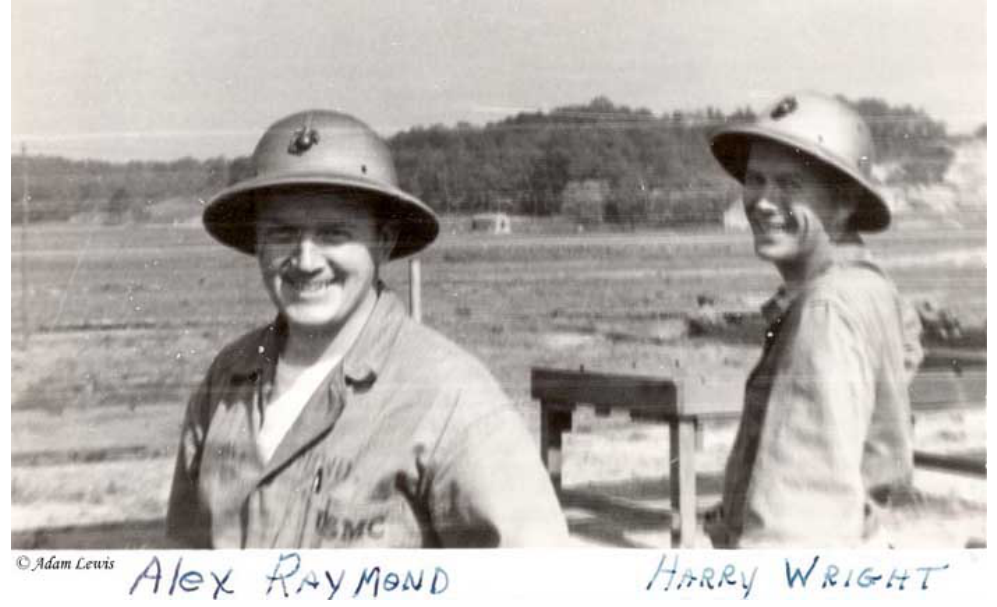
Shortly after joining the Marine Corps Raymond was sent to Quantico for training in the curriculum of the Aviation Ground Officer’s School (AGOS). Also in the class was Lt. Robert Cox, destined to become the Intelligence officer in VMTB-143 aboard the USS Gilbert Islands. This photo of Raymond is from Lt. Cox’s scrapbook.
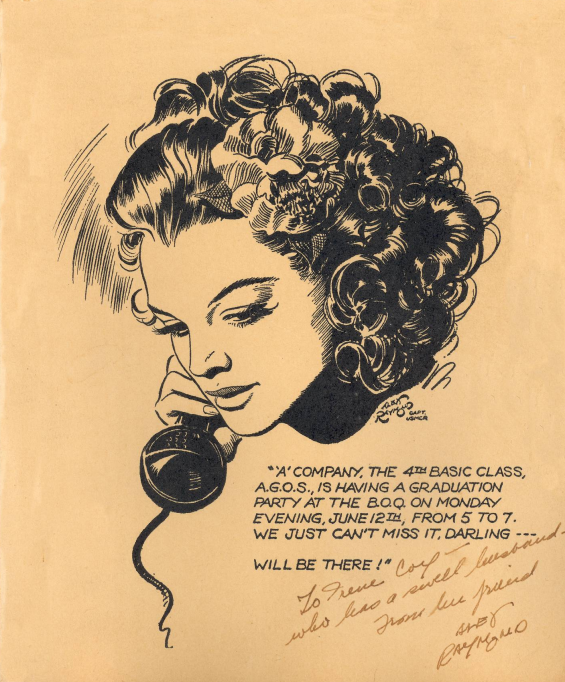
When the time came for graduation he drew this elegant invitation.
The personal note is to Lt. Cox’s wife Irene.
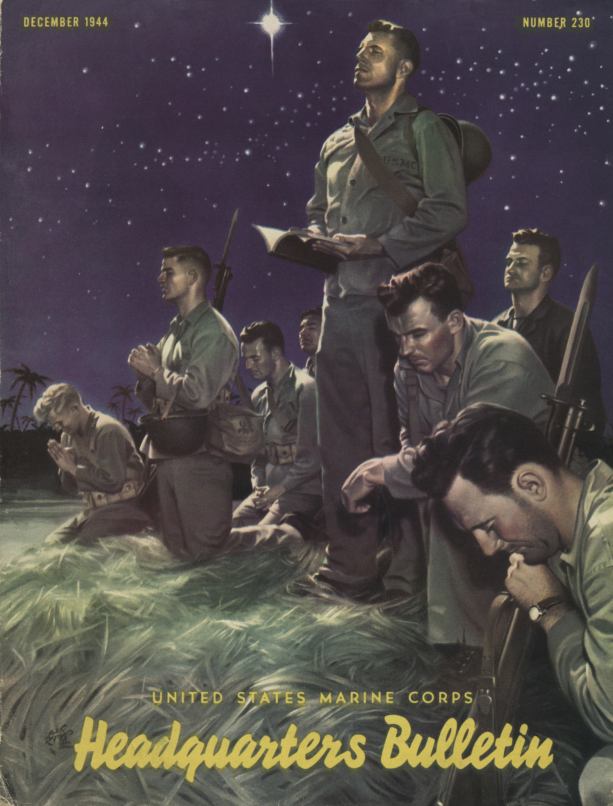
In 1944 Raymond made posters and patriotic images from a government office in Philadelphia. One of these works “Marines at Prayer” was destined to become a well-known and well-circulated image of Marines on a battlefield pausing for worship. Here it is on the December 1944 cover of the Marine Corp’s Headquarters Bulletin. On the inside cover is written “A painting by Capt. A.G. Raymond, USMCR, depicts in its impressive sincerity the worship and reverence that our fighting men carry to the very battle lines… The strength of manly character typified by the American Marine is vividly portrayed in this factual interpretation of men at prayer.” This is so moving and well executed it’s difficult to believe he was a cartoonist only a year before. Raymond had an urge to get closer to the action and was sent to the Marine Corps Air Station in Santa Barbara. There he created more images before going out on the USS Gilbert Islands in April 1945.
To the Marines on board the ship Raymond was a celebrity. After all,
they were teens when Flash Gordon came out and captured their
imaginations. But on the carrier he was apparently a down-to-earth
fellow who shared laughs, a few beers and good stories.
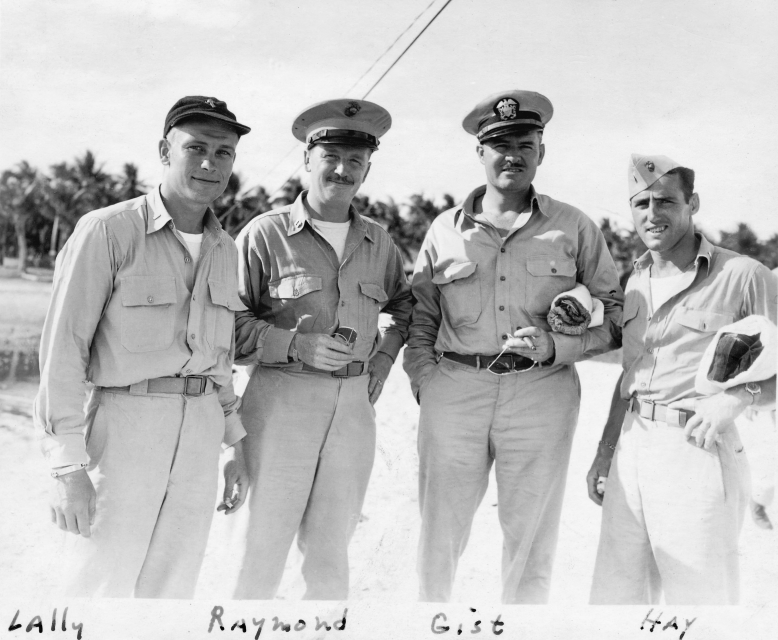
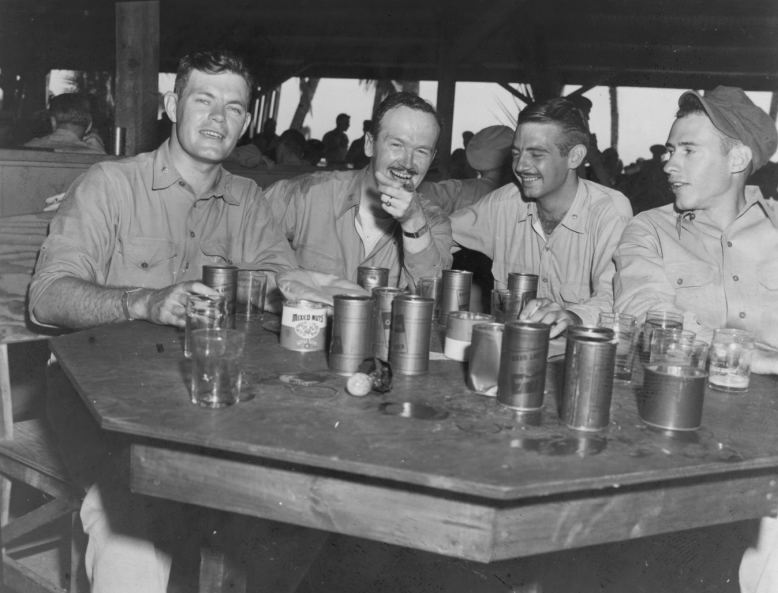
I’ve gathered some photos of Raymond from the veterans, such as these taken on the tiny island of Mog Mog, the beer capital of the Ulithi Atoll. The stop at Mog Mog was in May 1945, before the carrier had seen any action, and where Raymond helped Jack Lally celebrate a birthday
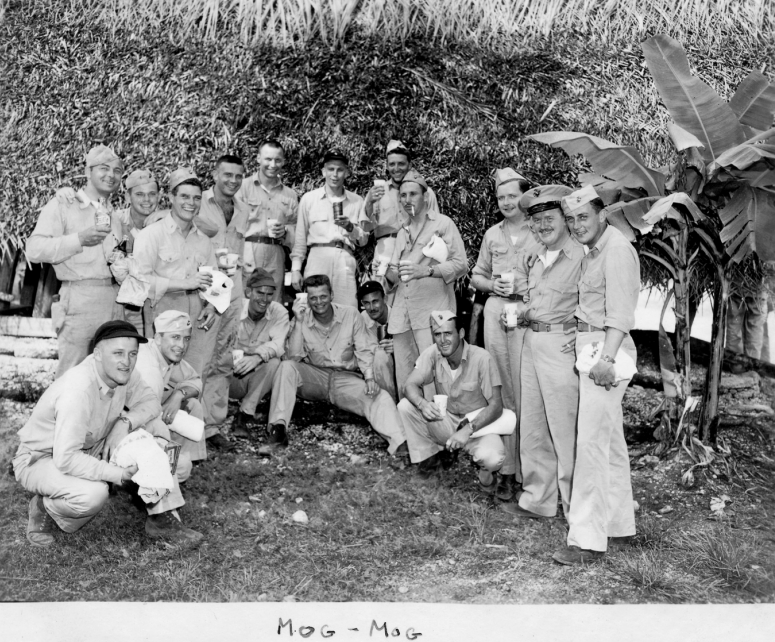
Also on Mog Mog, here’s a group shot with Marine officers, mostly pilots from VMF-512 and VMTB-143. Raymond is second from the right.
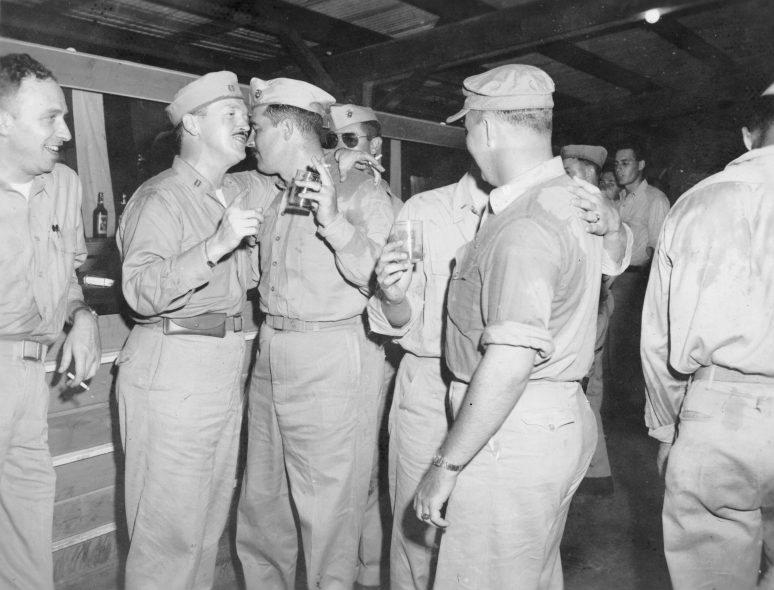
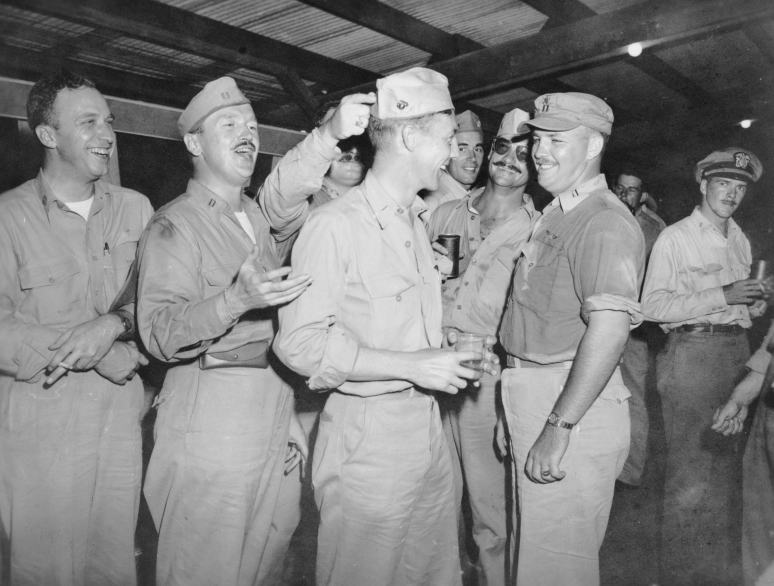
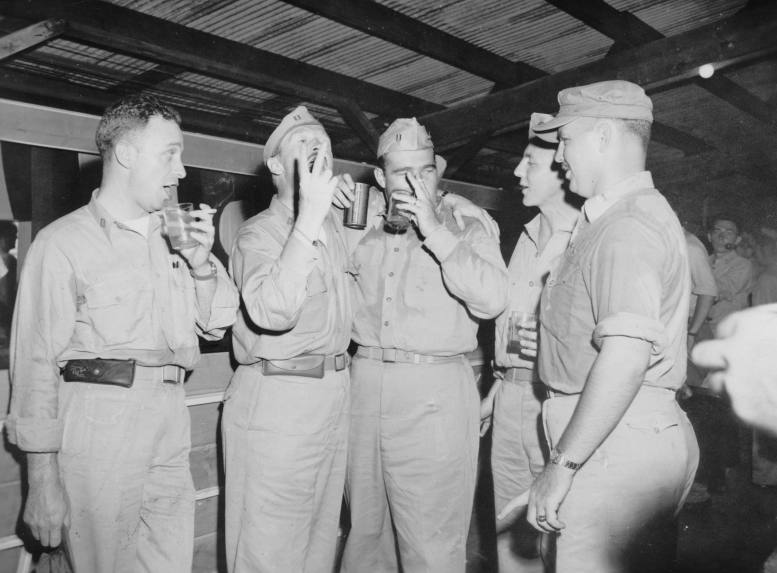
After a period of intense combat in June 1945, the carrier put in to Samar on Leyte, Philippine Islands, where these photos were taken in the Officer’s Club. They show the relief and good camaraderie of men who need a break from the battlefield. To the right, Alex Raymond (second from left) shares a few laughs with pilots from VMF-512.
In the pictures below, an apparently well lubricated group of USS Gilbert Islands Marines (Raymond is second from left and Captain Fulwood is to Raymond’s right), and others, are belting out a song before breaking out in a dance.
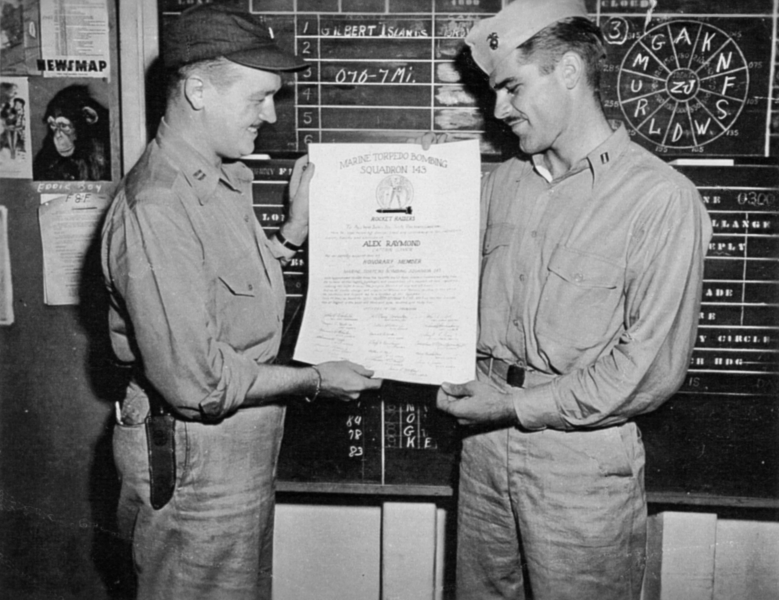
Raymond was well-liked by the men as exemplified by being made an honorary member of VMTB-143 in August 1945. In the photo to the right, squadron CO Captain John Worlund (right) presents Alex (left) with his honorary member scroll signed by all the officers.
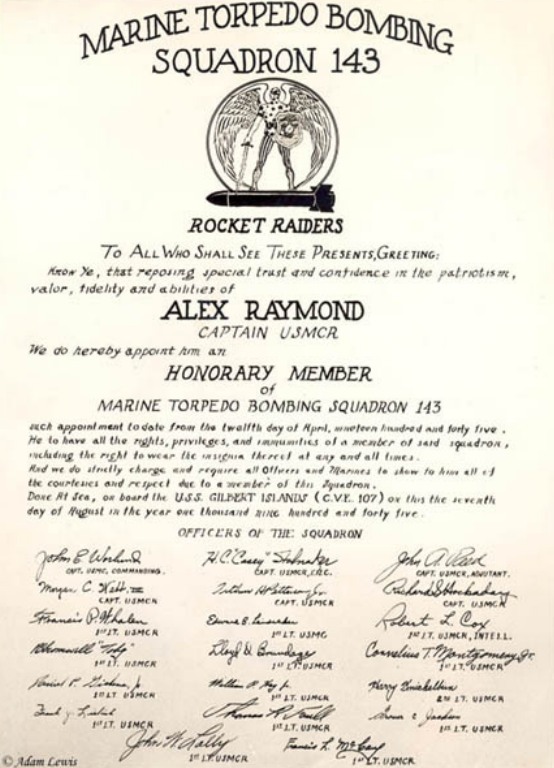
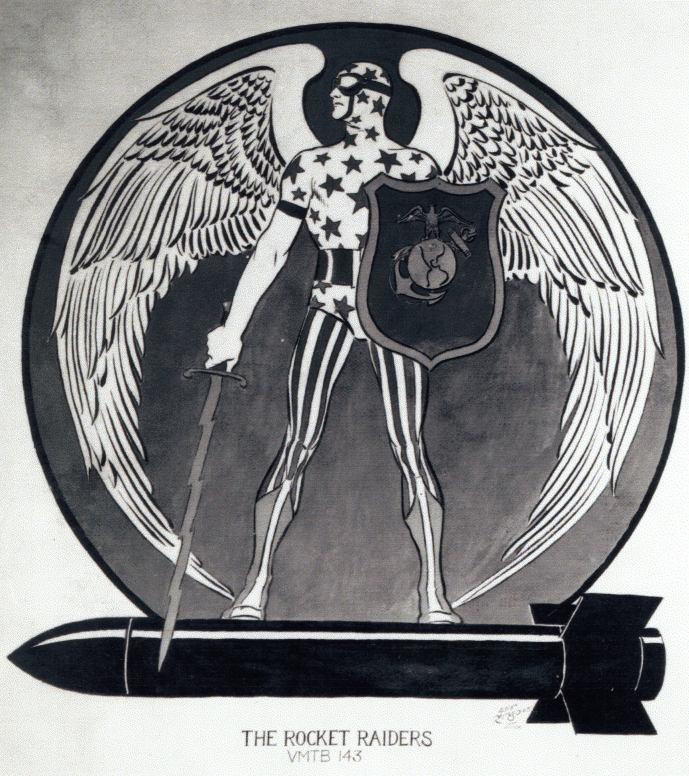
The drawing at the top of the scroll is the squadron patch Raymond designed for them in May 1945. He blended images of a masked (pilot’s goggles?) Flash Gordon style warrior; the Marine Corps emblem; red and white uniform with a field of blue stars; the warrior with wings (probably representing the air crew); the sword as a lightning bolt (representing perhaps aircraft which strike from above) and standing on an aircraft rocket. The squadron adopted the new name ‘The Rocket Raiders’.
Here’s a black and white image of Raymond’s artwork which was presumably done in full color. This beautiful patch ranks, in my opinion, high on any list of best-designed squadron patches of World War 2.
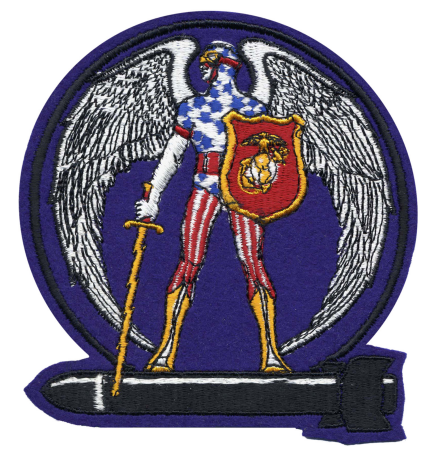
And here is an actual squadron patch:
Of Alex Raymond’s work, here is the piece I enjoy the most, ‘The Ready Room’. As soon as Tom showed it to me I recognized them as pilots from VMTB-143.
The painting had a long gestation period as Raymond left the USS Gilbert Islands about August 15, 1945 and must have finished the painting afterward since Lt. Cox notes in his scrapbook he never saw the final result. On the other hand some works appear to have been created in real time.
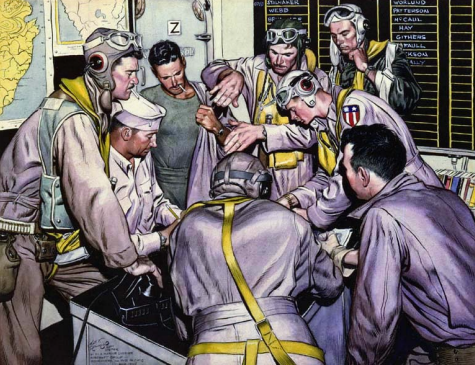
I confirmed their identities with Fritz Liebich (VMTB-143 pilot), and Mrs. Dan (Jeannie) Githens, who tells me her husband is depicted in the art. Standing at the left we have Captain Bill Patterson, seated to the left of him is the Intel Officer, Lieutenant Bob Cox. Putting his flight suit on is Lieutenant Billy Hay, then to the right is Captain John Worlund (hands flying), Lieutenant Frank McCaul (with his hand under his chin), Lieutenant Tommy Faull (looking down), Lieutenant Grover Jackson (left rear profile looking in), and (with his back to us) Lieutenant Dan Githens.
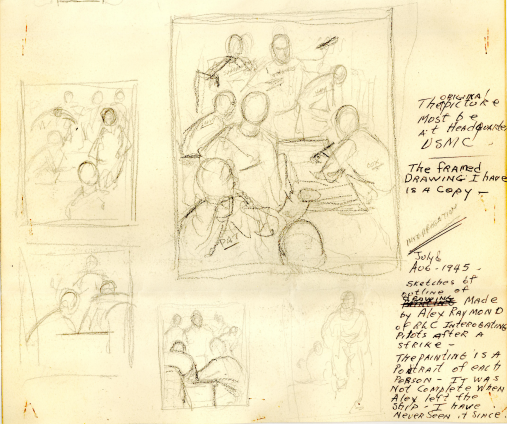
According to notes in Lieutentant Cox’s scrapbook the Ready Room was based on a photo Raymond took of the debriefing after the June 16, 1945 attack on Amami Oshima. Evidently he visualized the scene from many angles – here is his collage of sketches
Marine artists often had their works turned into prints by the Leatherneck magazine. The Ready Room was one. And this artwork of a Corsair taking off is another from the Leatherneck, loaned to me by Rob Cromwell, son of VMTB-143 pilot Robert Cromwell


The art conveys the hustle and bustle of a flight deck during operations, and is based on the photograph to the left.
The Marine Corps Gazette also used his art as illustrated by ‘Mail Call’ on the April 1946 cover.
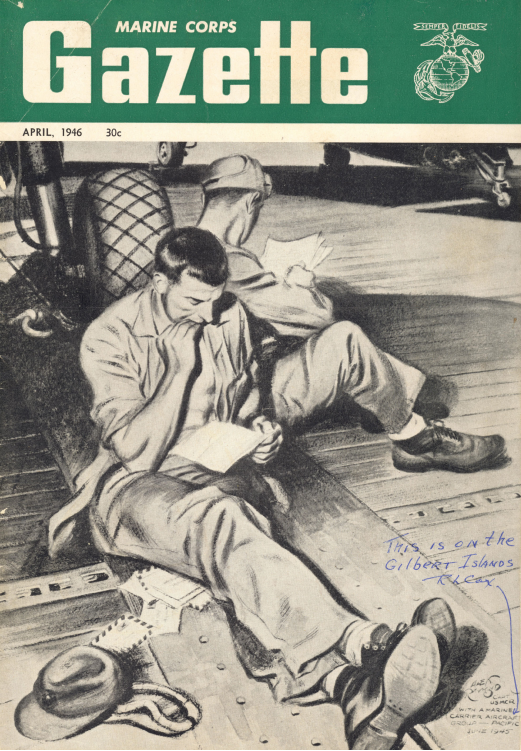
Tom Roberts’ book is a complete study of Raymond’s Art and Life. Along the way he’s accumulated personal stories and remembrances from the Marines who knew Raymond and those who actually appear in the art. It is a fascinating read! For more images of Alex Raymond and his work, check out the gallery.


